
Relic Hunting Tips: What a Roman Ring Discovery Can Teach Every Detectorist
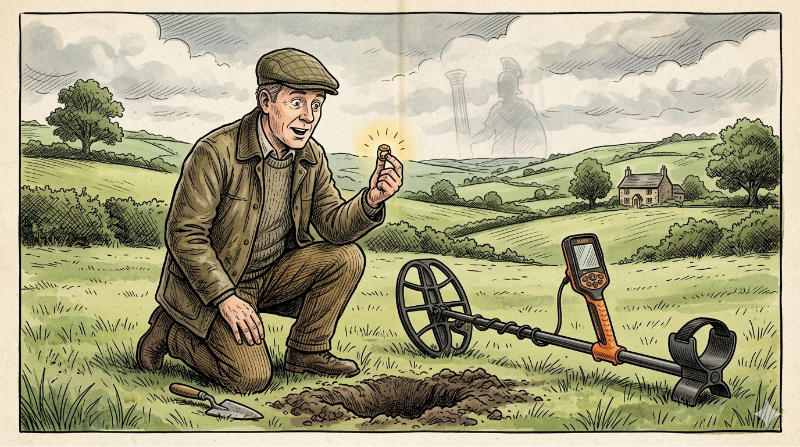
A story emerged from England about an amateur detectorist working a Somerset field whose detector signaled a buried object. The discovery turned out to be a Roman gold ring—described as "unparalleled" by heritage specialists. The South West Heritage Trust raised over £78,000 to acquire it, and the detectorist split his reward with a partner to help pay off his mortgage.
Beyond the headline appeal, this find illustrates "a consistent approach to relic hunting that any hobbyist can learn from."
Why Fields — Not Beaches — Are Often Where History Hides
Most associate metal detecting with beaches, but historically significant finds often come from farmland and fields. Roman roads, medieval settlements, and military routes crossed through agricultural areas before modern development. Ploughing gradually brings deeper objects toward the surface over centuries, making cultivated fields particularly promising.
The critical mindset involves asking not just "what's here?" but "what was here?" Research matters as much as detector features.
Research Before You Detect: The Part Most Beginners Skip
The Somerset ring wasn't found by random searching. Successful detectorists typically complete thorough homework first.
Useful research resources include:
- Historical and tithe maps (available through local archives)
- Historic England Pastscape database (UK users)
- Local history societies
Detectorists should seek old building footprints and field names suggesting historical significance (those containing "church," "castle," "ford," or "way"). After identifying a target area, obtaining permission becomes essential.
Getting Permission: A Practical Approach
Many beginners halt here, but most landowners respond positively to respectful requests. Approach farmers outside busy seasons, specify exact search locations and duration, explain that holes will be filled carefully, and offer to share finds.
In the UK, potentially significant items require reporting under the Treasure Act 1996. The Portable Antiquities Scheme encourages reporting all finds to maintain public goodwill. Rules vary significantly by country—check local regulations before detecting outside your property.
Detector Settings That Actually Matter for Relic Hunting
Ground balance proves critical for relic hunting. Old farmland often contains mineralized, iron-rich soil creating false signals and masking deeper targets. Detectors with manual, automatic, or tracking ground balance provide necessary flexibility.
Many historically important finds—medieval belt fittings, Roman brooches, Saxon strap ends—overlap in target ID ranges with common iron debris. Experienced relic hunters typically lower discrimination and rely on audio tone quality combined with target ID numbers rather than automatic rejection.
Recovery speed matters when encountering clustered targets. Slower swing speeds in promising areas allow the detector to fully process each signal and distinguish adjacent targets. Multi-frequency detectors can improve stability and target separation in mineralized ground, processing signals across multiple frequencies simultaneously.
Common Mistakes Relic Hunters Make
- Skipping research and randomly searching fields
- Setting discrimination too high, filtering out ancient objects alongside junk
- Rushing ground balance adjustments
- Failing to record find locations with GPS or sketches
- Recovering targets carelessly, damaging archaeological context
Final Tips
Most relic hunting sessions don't yield museum acquisitions. However, "a well-researched search with a properly configured detector almost always outperforms a luckier afternoon on unfamiliar ground."
Beginners should start small: research one historical area thoroughly, obtain permission from one landowner, and spend a complete session learning how ground conditions affect their detector.
Frequently Asked Questions
Do I need a special metal detector for relic hunting?
Not necessarily, but the detector should feature adjustable ground balance and discrimination. Multi-frequency models typically handle mineralized soil more reliably than fixed single-frequency options. Learn your detector's ground balance and tone system before field work.
What should I do if I find something old or potentially significant?
In the UK, items qualifying as Treasure under the Treasure Act 1996 (gold or silver items over 300 years old) must be reported to the local coroner within 14 days. Report other items to the Portable Antiquities Scheme. Check local heritage law in other countries, as regulations vary widely.
Is it legal to metal detect on farmland?
Only with explicit landowner permission. Farmland is private property even without fencing. Protected archaeological sites are generally off-limits regardless of permission.
What's the most important skill in relic hunting?
Research arguably matters more than detector settings. Understanding a location's historical use significantly improves search success. Detector skills—ground balance, swing speed, tone interpretation—follow as secondary priorities.